

The rule, stated plainly
The 1 percent rule says a rental property should bring in monthly rent equal to at least 1 percent of its purchase price. A $250,000 house should rent for $2,500 a month. A $180,000 duplex should bring in $1,800. If it does not clear the bar, you move on.
It is the most repeated piece of arithmetic in American real estate investing, and it survives because it is genuinely good at what it was built for: sorting a list of fifty listings into a shorter list in under a minute, without a spreadsheet, without a lender quote, without knowing the tax bill. That is a real job and the rule does it well.
The trouble starts when people treat a sorting tool as a verdict. I did this for the better part of a year. I filtered a list of local listings by the 1 percent rule every weekend, found nothing, and concluded my market was broken. My market was fine. I was using a screen as an answer, which is a bit like refusing to interview anyone whose resume is longer than one page.
A property that misses
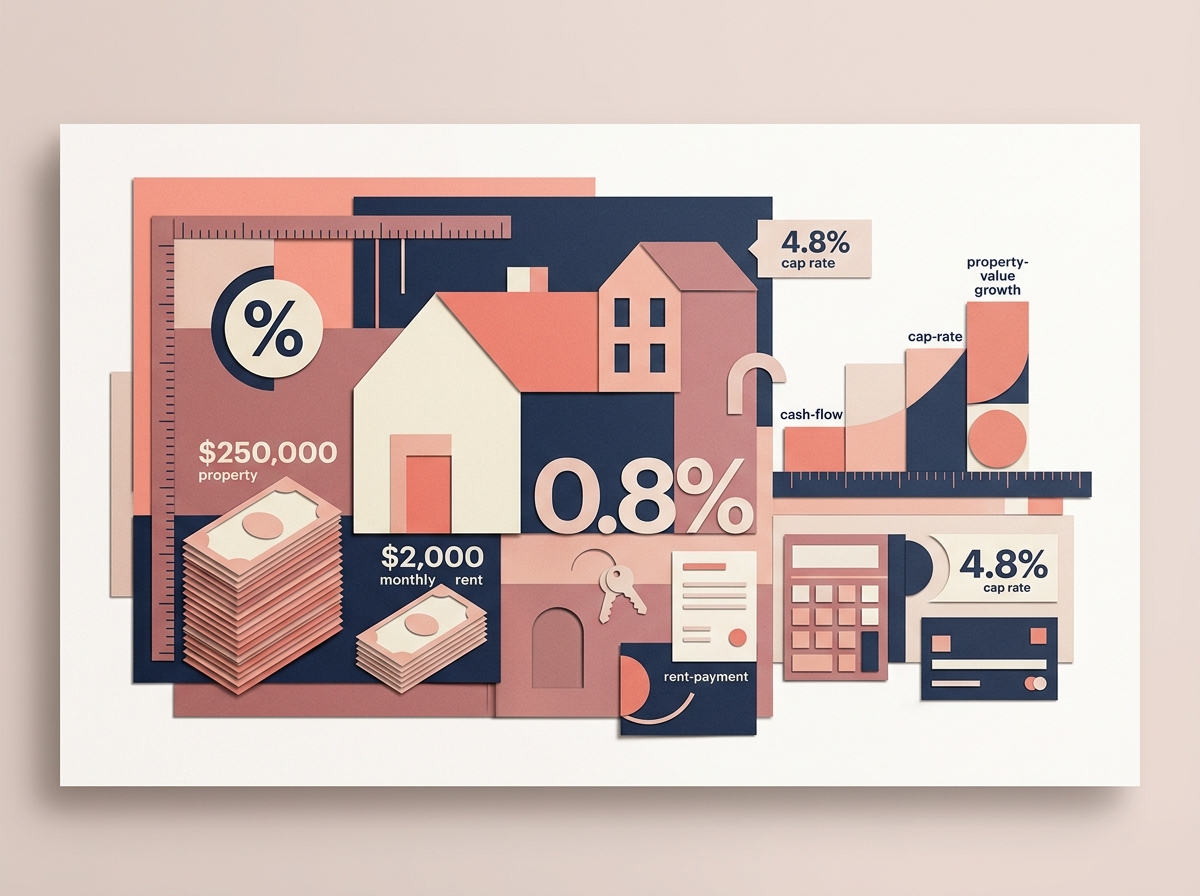
Here is the example I will use throughout. A property priced at $250,000 that rents for $2,000 a month.
Monthly rent divided by price is $2,000 over $250,000, or 0.8 percent. The 1 percent rule wants $2,500 a month at that price. It misses by $500 a month, which is a 25 percent shortfall, and on a strict reading of the rule you never open the listing.
Now run the same property through a second shortcut. Under the 50 percent rule, half of gross rent is assumed to disappear into operating expenses, which is $1,000 a month. That leaves $12,000 a year of net operating income, and against a $250,000 price that is a 4.8 percent cap rate. The gross rent multiplier, which is price divided by annual gross rent, comes out at 10.4.
So the same property is a hard fail on one screen and a specific, unremarkable, entirely analyzable number on another. Neither of those is a decision. The rental deal screener runs all three of these at once for exactly this reason, and the rental yield calculator will give you the gross and net yields side by side.
What the rule was actually a proxy for
Nobody cares about a monthly ratio for its own sake. The 1 percent rule is a compressed way of asking whether the rent to price relationship is strong enough to survive operating expenses and debt service and still leave something behind. Unpack it and the chain is short.
One percent a month is 12 percent of the purchase price in annual gross rent. Apply the 50 percent rule to that and you get a 6 percent cap rate. So the 1 percent rule is, underneath, a request for roughly a 6 percent cap rate before financing, using a deliberately pessimistic expense assumption.
Run our failing property through the same chain. Zero point eight percent a month is 9.6 percent of the price in annual gross rent. Half of that is a 4.8 percent cap rate, which is precisely the number the 50 percent rule produced. The two rules are not independent opinions. They are the same statement expressed in different units.
That matters, because it tells you what a miss actually means. A property at 0.8 percent is not disqualified. It is telling you it produces roughly a 4.8 percent unlevered yield if your expenses land at 50 percent of rent. Whether that is good depends on your cost of debt, your market, your hold period and your alternatives. Our guide to what is a good cap rate covers the ranges, and the 50 percent rule explained covers where that expense assumption is too harsh and where it is too kind.
Why so little clears it now
The rule circulated widely in an era when the relationship between purchase prices, rents and mortgage rates was different from today's. Rent to price ratios are set by local markets, and in a lot of American metros prices have moved further and faster than rents over the past stretch. When the denominator grows faster than the numerator, the ratio compresses. That is not a moral failing of the market or of the rule.
You do not need a national statistic to check this. Pull ten listings in your target neighborhood, find the realistic rent for each, and divide. If nothing comes close to 1 percent, your market has told you something specific: gross yields here are lower, so returns have to come from somewhere other than day one rent to price. Appreciation, forced value through renovation, better than average expense control, a rate you can refinance out of, or simply a longer hold.
That is a legitimate answer. It is also a riskier one, because more of the return sits in the future rather than in the monthly deposit. Markets where nothing clears 1 percent are not uninvestable. They just do not forgive a sloppy expense estimate the way a 1.2 percent market does.
A miss means look closer, not walk away
There are several ordinary reasons a good property misses the rule.
Rent may be under market. A long tenured tenant paying $2,000 in a neighborhood where similar units go for $2,300 is not a bad deal, it is a repricing opportunity with a timeline. The rule sees only the current number.
Expenses may be well under 50 percent. A newer building with tenant paid utilities, a warranty on the mechanicals and low turnover can run materially leaner, and that flows straight through to the cap rate the rule was proxying for.
The property type may be different. Small multifamily, properties with an existing accessory unit, or units where the rent includes something you do not actually pay for all distort a single ratio.
And your financing may be unusual. The rule says nothing about your loan, and cash on cash returns move enormously with leverage. Two buyers can look at the same 0.8 percent property and get very different answers. Run it through the cash on cash return calculator with your real terms before you decide, and read cap rate vs cash on cash for why those two numbers diverge.
A pass can still lose money
This direction gets less attention and causes more damage. Clearing 1 percent is not a green light.
High rent to price ratios often come attached to something. Very old housing stock with deferred capital expenditure. Neighborhoods with high turnover, where every vacancy costs you a month of rent plus a make ready. Property tax regimes that take a much bigger bite than the 50 percent assumption expects. Insurance markets that have repriced sharply. Rents that are high relative to price because the market is pricing in risk you have not looked at yet.
A property at 1.2 percent with 65 percent real expenses produces less than a property at 0.85 percent with 40 percent real expenses. The screen has no idea. This is arithmetic on assumptions rather than financial advice, and the assumption a screen makes for you is the one most likely to be wrong.
The same caution applies to the flipping cousin of these rules. The 70 percent rule caps your offer at 70 percent of after repair value minus repair costs, so a $300,000 after repair value with $40,000 of repairs caps the offer at $170,000. Useful, fast, and equally capable of being wrong about a specific house. We cover it in the 70 percent rule for flipping.
What I screen with instead
I still use rent to price. I just use it as the first of several gates rather than the only one, and I let a near miss through.
The sequence below takes about ten minutes for a property that survives the first thirty seconds, which is the right amount of effort. The full version is in how to analyze a rental property, and the rental property calculator handles the part where real numbers replace assumptions.
- Rent to price as a first pass. Anything above roughly 0.7 percent gets a second look rather than an automatic pass or fail.
- Cap rate using the 50 percent expense assumption, purely to see what the property looks like under a pessimistic view. Our example lands at 4.8 percent.
- Cap rate using real numbers: the actual tax bill, an actual insurance quote, a realistic vacancy allowance, and a capital expenditure reserve that assumes the roof is mortal.
- Cash on cash with your actual loan terms, because that is the number that hits your account.
- Debt coverage, if you are borrowing on the property's income rather than yours. See DSCR loans explained.
- A downside case: rent down 10 percent, one extra month of vacancy, and a $6,000 repair in year one. If it survives that, the screen was never the point.
So does it still work?
Yes, as a sorting tool, and no, as a standard. It works exactly as well as it ever did at the job of telling you which listings deserve ten minutes. It has never worked as a way of telling you which house to buy, and the fact that fewer properties clear it now says more about rent to price ratios in your market than about the quality of any individual deal.
The honest version is this. If a property clears 1 percent, look closer, because something is producing that yield and you should know what. If it misses, look closer, because the rule cannot see under market rent, lean expenses or your financing. In both directions the instruction is the same, which is a strong hint about how much weight a single ratio deserves.
Questions people ask
Not obsolete, just misused. It remains a fast way to sort a long list of listings, which is what it was built for. What has changed is that in many markets very few properties clear it, so treating it as a buy or pass standard leaves you with an empty list. Use it to decide what to analyze, then analyze properly.
There is no universally correct replacement, and anyone quoting one is guessing about your market. What I do is lower the gate rather than remove it, letting anything above roughly 0.7 percent through to a real analysis, and treating that threshold as a rule of thumb rather than a finding. The number that decides is the cap rate on real expenses and the cash on cash on your actual loan.
Directly. One percent monthly rent is 12 percent of the purchase price in annual gross rent, and applying the 50 percent expense assumption halves that to a 6 percent cap rate. Our failing example at 0.8 percent works out to 9.6 percent gross annual yield and a 4.8 percent cap rate. The two rules are the same idea in different units.
No, and that is one of its bigger blind spots. Rent to price is an unlevered measure, so two buyers with different down payments and rates can get very different outcomes from the identical property. Once a property passes the screen, move to cash on cash return with your real terms, because leverage changes the answer more than most screening ratios do.
Easily. High rent to price ratios frequently come with older buildings, heavier turnover, higher property taxes or insurance, or neighborhood risk that the market has already priced in. A property at 1.2 percent with 65 percent real operating expenses will underperform one at 0.85 percent with 40 percent expenses. The screen cannot see the expense side at all.