
The rule in one sentence
The 50 percent rule says that over the long run, roughly half of a rental property's gross rent will be consumed by operating expenses, before you make a single mortgage payment.
That is it. No adjustment for building age, no local tax rate, no view of your insurance quote. It is a blunt instrument, and it exists for one purpose: to stop you believing your own expense estimate. Almost every first analysis I have ever seen, mine included, arrives at an expense ratio in the thirties. Almost every set of actual results over a full ownership cycle lands higher. The rule is a thumb on the scale in the opposite direction from optimism.
It is a rule of thumb rather than a finding, and I will use it here the way I use it in practice: as a challenge to a number, not as a substitute for one.
The worked example
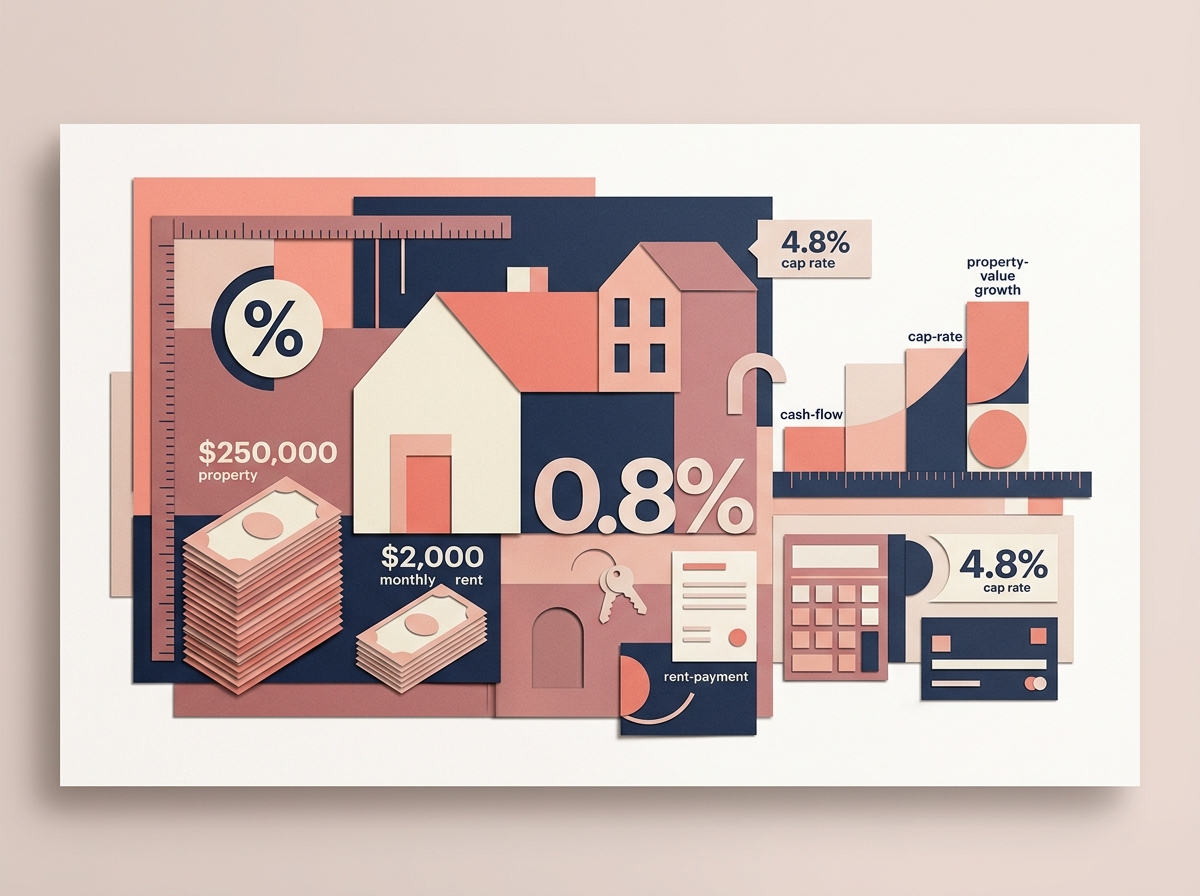
A property priced at $250,000 that rents for $2,000 a month. Gross annual rent is $24,000.
Apply the rule and half of the rent, or $1,000 a month, is assumed to go to operating expenses. That leaves $1,000 a month of net operating income, which is $12,000 a year. Divide $12,000 by the $250,000 price and you have a 4.8 percent cap rate. For reference, the gross rent multiplier on this property is $250,000 divided by $24,000, or 10.4.
Notice what the $12,000 has to do. It has to cover the entire mortgage payment and then leave something behind. A thousand dollars a month of net operating income against a loan on a $250,000 property is not a comfortable margin at most financing terms, which is the rule doing its job: it made a plausible looking deal look tight in about fifteen seconds. Whether it actually is tight is what the rental property calculator is for, and the cap rate calculator will convert any NOI you believe into a comparable yield.
This is arithmetic on assumptions rather than financial advice. The rule is an assumption wearing a number.
What is inside the 50 percent, and what is not
The single most common error is applying the rule and then subtracting property taxes again. The 50 percent is meant to cover every operating cost of the property.
It includes property taxes, insurance, ongoing maintenance, capital expenditure reserves, vacancy, management, and the routine costs of turnover. It excludes exactly one thing: debt service. Principal and interest come out of what is left, which is why the output of the rule is net operating income and not cash flow.
Debt is excluded deliberately. Two investors can buy the same building with completely different loans, and the property's operating performance does not change because one of them put more money down. That separation is the same reason cap rate ignores financing, and it is worth keeping clean in your own models.
- Inside the 50 percent: taxes, insurance, maintenance, capital reserves, vacancy, management, turnover costs, and the small recurring services.
- Outside the 50 percent: principal and interest, and any capital you spend to improve rather than maintain the property.
- Output: net operating income, not cash flow. Cash flow is what survives the mortgage.
The lines investors forget
Here is where the rule earns its keep. When someone tells me their expenses run 30 percent, it is almost never because they found a magical property. It is because the list they are using is short.
This is the mistake I made on my first small multifamily. The seller handed over a genuine ledger showing expenses at roughly a third of rent, and I underwrote to it. What I never asked was who did the work. He was a retired tradesman who handled every repair himself and had not touched the roof in two decades. My first full year of ownership landed far closer to the rule of thumb than to his paperwork, and the difference was not bad luck. It was the labor and the deferred capital he had never been billed for.
- Property taxes after reassessment, which in many jurisdictions follow the sale price rather than the seller's old basis.
- Insurance at a current quote rather than the seller's renewal, plus a separate umbrella liability policy.
- Vacancy, which is not a bill but is absolutely a cost.
- Turnover: make ready, paint, carpet or floor repair, cleaning, rekeying, listing fees, and any leasing commission.
- Capital reserves for the roof, HVAC, water heater, appliances, flooring, exterior paint, windows, driveway and sewer line. Each of these has a lifespan and a price, and dividing one by the other is not optional.
- Management at market rate, even if you self manage. Your time is either worth something or you have hired yourself at zero dollars an hour.
- Lawn care, snow removal, pest control, gutter cleaning and the seasonal services a tenant will not do.
- HOA dues and, more painfully, HOA special assessments.
- Utilities the tenant does not pay: water and sewer, trash, common area electric in a multi unit.
- Legal fees, eviction costs and unpaid rent that never arrives.
- Bookkeeping and tax preparation, rental registration and inspection fees, and any licensing your city requires.
- Bank fees, software subscriptions and mileage, which are individually trivial and collectively not.
When 50 percent is too harsh
The rule is not always right, and it is systematically wrong in a few identifiable directions.
It is too harsh on newer buildings. A house built five years ago with warranties still running, a young roof and modern mechanicals genuinely has lower maintenance and lower reserve requirements than a 1940s duplex. Not zero, because the reserve is for future replacement rather than present repair, but lower.
It is too harsh where the tenant pays the utilities. If water, sewer, trash, gas and electric are all in the tenant's name, and the lease puts lawn and snow on them too, a whole category of expense simply is not yours.
And it is structurally too harsh on high rent properties, which is the point almost nobody makes. Most operating costs scale with the building, not with the rent. A roof costs what a roof costs. A property renting for $3,000 a month is allotted $18,000 a year of expenses under the rule, and a nearly identical building renting for $1,200 a month is allotted $7,200 for the same roof, the same furnace and the same insurance policy. The rule is generous to the expensive property and stingy to the cheap one, and it is the cheap one where people get hurt.
When 50 percent is far too kind
The other direction is more dangerous because nobody expects it.
Older properties with deferred maintenance can run well past half. If the roof, the electrical panel, the sewer lateral and the windows are all near the end of their lives at once, the reserve requirement in the first few years of ownership is not a smooth annual figure, it is a series of large checks.
Heavy turnover properties blow through it too. Every vacancy is lost rent plus a make ready plus a re lease. A unit that turns every year in a market where a turn costs a month of rent and $1,500 of work has an expense structure that no percentage of gross rent describes well.
So do high tax jurisdictions, buildings in insurance markets that have repriced hard, condos with active special assessments, and any property where you pay the water bill for tenants who have no reason to fix a running toilet. The rule assumes an average, and averages are made of properties that are worse than average as well as better.
How to use it without letting it decide
I run the rule twice on every property, at two different points in the process, and both times it is a question rather than an answer.
The first time is during screening, before I know anything, purely to see whether the deal is plausible under a pessimistic view. The rental deal screener does this alongside rent to price and gross rent multiplier, and our companion piece on whether the 1 percent rule still works explains why those two shortcuts are really the same statement in different units.
The second time is after I have built a real expense budget from real quotes. I compare my number to the rule, and if I have come in meaningfully below 50 percent, I have to say out loud which specific line I believe is lower than average and why. Newer roof, tenant pays everything, low tax county, self managed and I am counting my own labor honestly. Those are acceptable answers. Optimism is not.
- Screen with it, then forget it while you build a real budget from actual quotes and the actual tax bill.
- Compare your budget back to the rule and justify any gap line by line.
- Never subtract taxes or insurance separately after applying the rule. They are already in there.
- Keep debt service outside it. NOI first, then cash flow.
- Stress test the result with a vacancy and a $6,000 repair before you commit.
From rule of thumb to real number
A rule of thumb is a way of being approximately right when precision is unavailable. Once precision becomes available, which is usually the moment you have a tax bill, an insurance quote and an inspection report in hand, the rule has done its job and should get out of the way.
The properties that hurt people are rarely the ones that failed a screen. They are the ones that passed because the expense estimate was built out of hope. If you want the longer version of how to replace assumptions with numbers, we walk through it in how to analyze a rental property, and the errors that recur most often are in first rental property mistakes. For the part where the property's cash flow meets your household finances, the budget calculator is a blunter but more useful reality check than most investors expect.
Questions people ask
No. It covers operating expenses only, which means taxes, insurance, maintenance, capital reserves, vacancy, management and turnover. Principal and interest come out of whatever is left. That is why the rule produces net operating income rather than cash flow, and it is also why two investors with different loans on the same building get the same NOI and very different cash flow.
Often it is too harsh. A recently built house with tenant paid utilities, young mechanicals and low turnover can genuinely run leaner. What it cannot do is run at zero reserves, because the reserve is money set aside for a roof that has not failed yet rather than a repair you are making today. If you underwrite below 50 percent, name the specific lines that are lower and say why.
Halve the gross annual rent to get net operating income, then divide by the price. On a $250,000 property renting at $2,000 a month, gross rent is $24,000, NOI is $12,000, and the cap rate is 4.8 percent. It is the same arithmetic that sits underneath the 1 percent rule, which asks for 12 percent gross annual yield and therefore implies a 6 percent cap rate at 50 percent expenses.
Use them as evidence, not as a forecast, and interrogate them. Ask who performed the maintenance and whether that labor was ever paid for. Ask when the roof, furnace, water heater and sewer line were last replaced. Ask whether property taxes will be reassessed on your purchase price. A long time owner operator's ledger frequently omits exactly the costs a new owner will face immediately.
They do different jobs, and they work best together. The 1 percent rule looks at the revenue side, asking whether rent is high enough relative to price. The 50 percent rule looks at the expense side, asking whether that revenue survives contact with reality. Neither is a decision. Both are ways of deciding what deserves a real analysis.