

Why dividing a salary by 2,080 gives you the wrong number
Almost every new freelancer prices the same way. They take the salary they used to earn, divide by the hours in a working year, and quote that. It feels rigorous. It is the most expensive mistake in this line of work.
You can see why it is tempting. Put $85,000 into the salary converter at 40 hours a week across 52 weeks and you get $40.87 an hour, $1,634.62 a week, or $7,083.33 a month. Clean numbers, and useful when comparing two job offers, which is what that calculation is for.
It is the wrong tool for freelance pricing because it assumes two things that are true for employees and false for you: that all 2,080 hours are paid, and that somebody else covers everything which is not salary.
What your employer used to pay that you now pay
A salary is the visible part of a much larger number. When you go freelance, the invisible part moves onto your side of the table and nobody sends a memo about it.
Self employment tax catches people hardest. As an employee, your employer paid half of your Social Security and Medicare contributions. Working for yourself you pay both halves, 15.3% combined on most of your net earnings, before income tax is calculated at all. There is no withholding either, so the money sits in your account looking like yours until it is suddenly due.
- Both halves of Social Security and Medicare, instead of one
- Health insurance with no employer contribution, and retirement with no match
- Vacation, sick days and public holidays, which are now unpaid
- Laptop, software, phone, internet, insurance, accounting
- Every hour spent on sales calls, proposals, invoicing and chasing payments
The calculation that actually works
Start from the end. Decide what you want left over, add what the business costs to run, then divide by the hours you can genuinely sell.
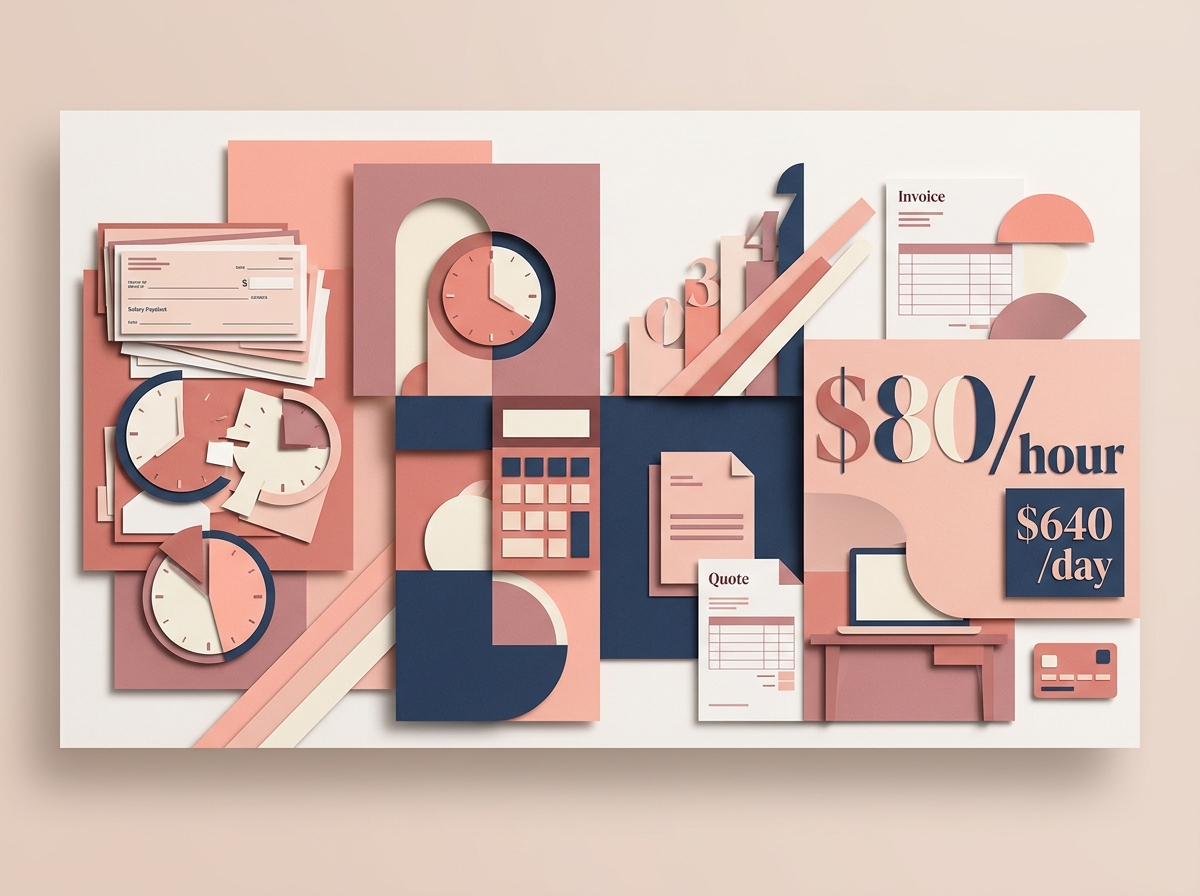
Here is the worked example. Target income of $80,000. Business costs of $12,000 a year covering software, insurance, hardware and accounting. The business needs $92,000 of revenue, because $80,000 plus $12,000 is $92,000. Now the hours: 25 billable hours a week across 46 working weeks is 1,150 billable hours. Divide $92,000 by 1,150 and you get $80 an hour. At eight hours, that is a $640 day rate.
Notice how far that sits from the $40.87 the salary division produced. Same person, similar target, double the hourly number. The freelance rate calculator runs this with your own figures. One point of honesty about that $80,000: it is what the business has left after costs and before income and self employment taxes. If you want a specific amount after tax, set the target higher.
Why 25 billable hours a week and not 40?
This is where most rate calculations fall apart. You do not have 40 sellable hours in a week. The people who claim they do are usually working sixty.
Your week also contains finding the next client, writing proposals that go nowhere, invoicing, chasing last month's invoice, calls that could have been email, bookkeeping, and learning what the next job needs. None of it is billable and all of it is mandatory.
Twenty five billable hours out of a full week is a realistic sustained target. In a bad month it is fifteen. The 46 weeks matters just as much, because it leaves room for vacation, holidays and the week you get the flu. Build a rate on 52 weeks and 40 hours and you have priced yourself as a machine that never rests.
Hourly, day rate, or fixed price?
The $80 hour and the $640 day are the same number wearing different clothes, but they behave differently in a negotiation. Hourly suits open ended work where the scope moves. Day rates suit work that needs your full attention in blocks, and they end the conversation where a client tries to buy 45 minutes of your Tuesday.
Fixed pricing is where the money is and where the danger is, because you keep the upside when you are fast and eat the cost when you are slow. Quote one by estimating the hours honestly, adding a buffer for revisions, then multiplying by your rate.
If part of your income comes from selling something rather than your time, the shape changes. Say you have $3,000 of fixed costs, a product at $45, and $18 of variable cost per unit. Each sale contributes $27, which is 60% of the price. Divide $3,000 by $27 and you need 112 units to break even, roughly $5,040 of revenue. The break-even calculator handles any combination, and margin versus markup is worth reading first, because confusing the two is how a healthy looking product loses money.
The project where my effective rate halved
I quoted $4,000 for a fixed scope project and felt good about it. The hands on work looked like 40 hours, so I was earning $100 an hour, comfortably above my target rate.
I had counted only the hours spent producing the deliverable. Not the kickoff call, the two follow up calls, three rounds of revisions, the afternoon reformatting everything for a stakeholder who joined late, or the invoice and its reminders. The job took 82 hours. Four thousand dollars divided by 82 is just under $49 an hour, less than half of what I thought I had agreed to.
The fix was not raising my rate. It was learning that revisions and coordination are part of the work. Now I estimate the hands on hours, add a block for both, and write the number of revision rounds into the quote.
When and how to raise your rate
Rates do not rise on their own and no client will suggest it. The signals are easy to read: you are booked out weeks ahead, nobody flinches at your price, or you quietly resent a project you agreed to at last year's number.
Raise on new clients first. Quote the new rate to the next person who asks, see how it goes, repeat. That gives you evidence before you touch an existing relationship. For current clients, give notice and keep it short. One sentence saying your rate moves from $80 to $95 an hour on the first of next month is enough. No apology and no essay, because a long justification invites a negotiation.
Recalculate rather than guessing. Costs rise, your target should rise, and your billable hours may have changed.
The three documents that get you paid
Pricing is half the job. Getting the money into your account is the other half, and it runs on three documents people routinely confuse.
A quote comes first. It states what the work is, what it costs, what is not included, how many revision rounds are covered, and how long the price holds. Its real value is the scope, not the number: a quote is what you point at when the project starts growing. Build it with the quote generator. An invoice comes on delivery. It needs a number, dates, both sets of details, a line by line breakdown, the total, and clear payment terms. Vague invoices get paid late for boring administrative reasons, so use the invoice generator. A receipt comes after the money arrives, confirming payment for the client's bookkeeper and for your records at tax time, and the receipt maker makes one in a minute.
Get the quote agreed in writing before you start, every time, even with a friend. If you are wondering whether an emailed approval is binding, what counts as signed for electronic signatures covers it. These generators run in your browser, so client names and amounts never leave your device.
Questions people ask
Add your target income to your annual business costs, then divide by genuinely billable hours. For example, $80,000 plus $12,000 of costs is $92,000 of revenue. Billing 25 hours a week for 46 weeks gives 1,150 hours, so that is $80 an hour, or a $640 day rate.
Because it assumes every hour is paid and that an employer covers your payroll taxes, insurance, equipment and downtime. As a freelancer you pay all of it and bill far fewer hours. An $85,000 salary divides to $40.87 an hour, roughly half of what the equivalent freelance rate needs to be.
Around 25 is realistic for an established freelancer working a full week. The rest goes to sales, proposals, invoicing, admin and learning. Planning on 40 means every unbillable hour eats into your income, which is how underpricing happens unnoticed.
A quote is a priced offer with the scope defined, sent before the work starts. An invoice is a request for payment, sent on delivery, with terms and a reference number. A receipt confirms payment was received. Sending an invoice when you meant a quote is a common and awkward mistake.
Yes, but test it on new clients first so you have evidence. When you raise it for existing ones, give notice, state the new number and the start date, and keep it to a sentence. Long justifications invite a negotiation that a simple statement avoids.